
Why Organic Traffic is the Best Long-Term Investment to Increase Website Traffic Organically

Would you like to increase traffic to your site? There’s no need to spend money on advertisements. It only requires the right strategy. Learning how to increase website traffic organically may take time, but the results are long-lasting, cost-effective, and highly valuable in the long run.

This blog will guide you through each step in a simple, clear, and actionable way.

Here is what to do:

  • Go through the free Keyword Planner by Google.
  • Search and identify low-competence long-tail keywords.
  • Pay attention to the keywords, which correspond to what the audience actually searches.
  • Research to find what your competitors are ranking.

Long keywords, such as best home workout without equipment or best home workout with

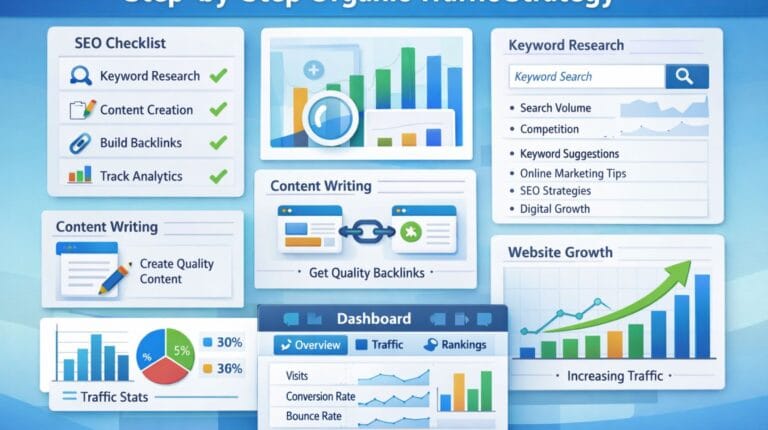
Step-by-Step Organic Traffic Strategy

Make Writing Content That Does Help People.

The task that Google has is to demonstrate the most desirable response. Your job is to be that answer.

  • Good content must:
  • Solve a specific problem
  • Be simple to read and comprehend.
  • Give real, actionable advice
  • Written not only algorithms but also by humans.
  •  
  • Avoid filler content. Value must be added to each sentence. When it is not useful to the reader, get rid of it.

Master On-Page SEO

On-page SEO refers to the optimization of every page of your webpage. It informs the search engines of what your content entails.

Key on-page SEO elements:

Add your keyword to the title.

Naturally, the first paragraph.

And add H2 and H3 headings throughout.

Compose an alluring meta description.

Keep URLs short and clear

Add alt text to all images

Link to other pages on your site.

It is free to take these steps. But they cause a massive difference in your rankings.

 Incorporate Internal Links to retain the visitors’ interest.

Internal linking refers to linking a page of your website to another page. It assists customers in locating additional content of yours. It also informs Google of the important pages.

As you write a new post, come back to the previously published posts and put a link to it. This is a very basic habit that improves your ranking in search engines in the long run.

 Revise Old Content regularly.

Aged blog posts may lose their positions. But they can also be revived.

Go back to older posts and:

Add new information

Fix outdated stats and facts

Enhance the architecture and layout.

Ad added to the keywords naturally.

The updated content tends to be put above the new one. Google is a sucker for new, correct information.

The Right way to build Backlinks.

Backlinks are links that point to your site. They are among the most successful ranking signs of Google.

The way to have good backlinks:

Write research-based/fold posts.

Develop some helpful free tools or resources.

Blog on reputed websites within your field.

Get mentioned in round-up pieces.

Post in relevant communities on the Internet.

Never buy backlinks. Google punishes the sites that attempt to cheat the system. Pay attention to your links through your content that is worth sharing.

Fix Your Technical SEO

Great content cannot work even when your website is not technical. Technical SEO maintains the optimality and friendliness of your site to the search engine.

Check these right now:

  • Site speed– slow pages lose visitors. Go to Google PageSpeed Insights.
  • Mobile design – over 60 percent of searches occur on mobiles. Your website should be beautiful on mobile devices.
  • Core Web Vitals — Google values loading, user interaction, and image stability.
  • SSL certificate — all your websites should be on HTTPS, and not on HTTP.
  • Busted links — correct or delete any broken links on your website.

These problems will be fixed, and your organic ranking will be improved.

Content and SEO Concept

Optimize for Search Intent

The cause of a search is search intent. Google aims at aligning the appropriate content with the appropriate intent.

Search intent can be of four types:

  • Informational– the user desires to know something.
  • Navigational — the user is the one who would like to visit a particular site.
  • Commercial– before purchase, the user is comparing.
  • Transactional – the customer is willing to purchase.

You should always question yourself before you write any post; what does the user really want? Produce material that is consistent with their purpose. That is the key to understanding how to boost the traffic on the websites organically in the present competitive environment of the search market.

Target Featured Snippets

The prominence of featured snippets also goes on the first page of Google, somewhat above the rest of the links. One can get you triple the traffic at once.

To win featured snippets:

  • Respond to typical questions concisely and directly.
  • Make use of points and lists.
  • Limit your responses to 60 to 40 words.
  • Write some headings, such as what is… in the form of questions, or “How does…”

Organize to respond to queries in less time. Google rewards clarity.

Use the Social Media to attract traffic back to your site.

The signals made by social media do not directly enhance the ranking of SEO. But they literally bring in actual traffic to your site. Increased traffic means increased links and a more user-friendly interface.

The best sources to spread your content:

Pinterest – the best to use with unchanging content and images.

LinkedIn -best in business and career matters.

Facebook Groups– reach niche groups.

YouTube — record short videos that refer to your blog.

Rewind your blog posts to socials, short videos, and infographic materials. Communicate directly to a larger audience.

Traffic That Grows Even While You Sleep

Build Topical Authority

Google rewards those sites that address a topic in-depth. This is referred to as topical authority.

Rather than posting some arbitrary entries on various topics, create groups of similar material. For example:

  • A single pillar head on a wide subject.
  • Several lengthy posts on sub-topics.
  • You know, they have internal connections with each other.

This is a tactic that informs Google that you are a guru in your niche. The greater authority you create, the higher all of your pages on your site are.

Monitor Your Performance using the appropriate tools.

You are unable to measure what you can improve. Free tools can be used to monitor organic growth.

Must-use tools:

  • Google Search Console — find out what words drive visitors to your site
  • Google Analytics 4 – follow actions of small persons and sources of traffic.
  • Ahrefs or Semrush (Available Free) — backlink analysis and keyword rankings.
  • Screaming Frog — check your site to identify technical problems

Review your data every month. Double down on what works. Fix what doesn’t.

Top 10 Deadly Organic Traffic Traps.

The following are some of the mistakes that most beginners make:

  • Apost on books of this quality merely to write more.
  • Ignoring mobile users
  • Ripping off what other websites have posted.
  • Crammed with keywords.
  • Skipping meta descriptions
  • No new updates to old blog posts.
  • Creating junky or bad backlinks.

A misstep can take months to recover. Stay consistent. Stay ethical. Stay focused.

LSI keywords to support this topic.

To be well-ranked, you should use related words naturally in your content. These are: search engine optimization tips, optimistic search strategy, free blog traffic, content marketing knowledge base, SERP visibility, web page ranking factors, building natural links, domain authority growth, user experience signals, and the strategy of evergreen content.

Use them where they fit. Never force them.

Final Thoughts

Organic growth is just not an overnight event. But there is a clear path. Adhere to these strategies, and your website will increase, month by month, year by year.

All expert websites that you like today started at the beginning. The difference is that they continued.

You now understand how to get the traffic on the site in an organic way. The next step is yours. Select one of these guides. Start today. Build momentum. And watch your traffic grow.


Frequently Asked Questions (FAQs)

You will get good results in 4 to 6 months on most sites. Some competitive niches are slower. Consistency is key.

 No. Quality beats quantity. Seven hurried posts are inferior to two well-researched posts each week.

 Yes, particularly the low-competition keywords. However, backlinks will enable you to rank quickly.

 Absolutely. Organic search is the biggest source of traffic to a website in the world.

 How-to instructions, listicles, comparisons, and frequently asked questions have always done well on search engines.

Need Help?
0
Would love your thoughts, please comment.x
()
x